
Overview
Hydraulic four-column presses for deep drawing, metal forming and hot moulding of melamine, rubber and silicone, designed and built in 10th of Ramadan City, Egypt.
A four-column press carries its moving platen on four guide columns. The columns keep the platen parallel to the bed under load, so force is spread evenly across the die and parts come out the same from the first cycle of the shift to the last.
We build this family in two main configurations. The deep-drawing press (PSG-HPDD), from 40 to more than 1000 t, gives precise pressure control for metal parts with deep or complex shapes. The thermal forming press (PSG-HPTF), from 80 to more than 600 t, combines heat and pressure for melamine, rubber, silicone and porcelain, and its control stores more than 100 programs. It comes with fixed platens, or with a lower platen that slides out of the press for loading and ejection, keeping the operator's hands away from the hot die.
No two applications need exactly the same press. Force, table size, daylight, stroke, heating and controls are set from your part, your material and your output target. Send us a drawing or a sample and the number of parts you need per shift, and our engineers will propose a configuration.
How it works
Models


Inside a four-column press
What each assembly does, with the press taken apart.
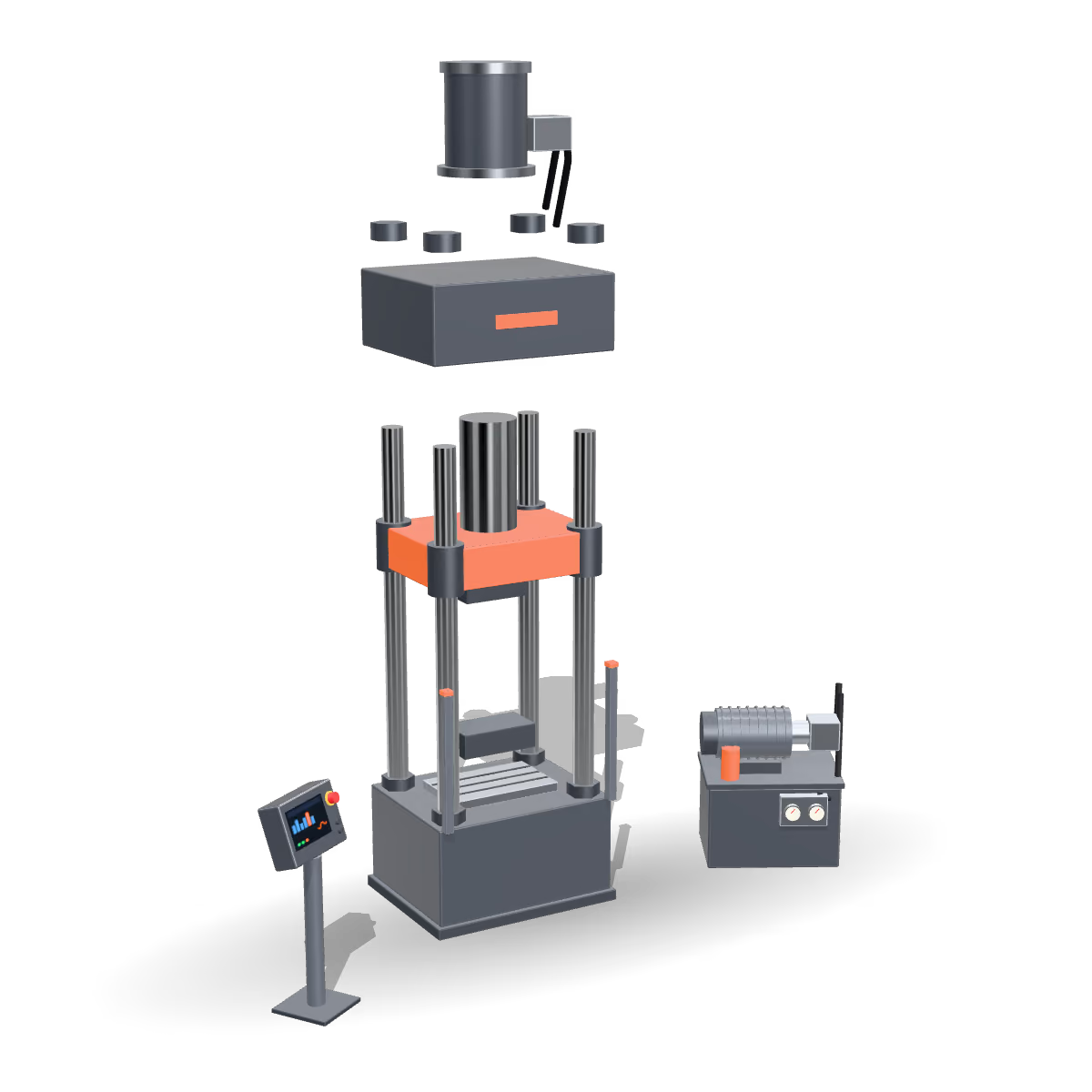
Step 1 of 4
The frame
The bed and the four columns hold the press together: the columns carry the press force from the bed to the crown.
- Bed
- Columns
Step 2 of 4
The crown and the cylinder
The main cylinder sits in the crown. The oil pressure in it becomes the force on the slide.
- Crown
- Main cylinder
Step 3 of 4
The slide and the tools
The slide is guided at all four corners, so it stays parallel to the bed and the tools meet squarely.
- Slide
- Lower tool
Step 4 of 4
Power and control
The power unit supplies the oil. On the operator panel, pressure, position and timing are set and held.
- Power unit
- Operator panel
Questions
What information do you need to prepare a quotation?
The more we know about the job, the more accurate the quote. For a press: the part or product, the material and its thickness, the force you expect to need, table size, daylight and stroke, heating if any, and the output per shift. For a baler: the material, your daily volume, the floor space available and the bale weight you want.
Drawings, photos of the current setup or a sample part all help. If you are not sure about some values, say so, and our engineers will work them out with you.
What is the difference between fixed platens and a moving lower platen on a thermal press?
On the fixed-platen version, the operator loads and unloads the die inside the press. On the moving (shuttle) version, the lower platen slides out of the press for loading and ejection, then returns for pressing.
The shuttle keeps the operator's hands away from the hot pressing area and makes loading easier. Both versions are available on the PSG-HPTF thermal forming press, from 80 to more than 600 t.
How do I estimate the press force (tonnage) I need?
Required force depends on the process, the material and the size of the part. For moulding, it is mainly the pressure the material needs multiplied by the projected area of the part. For deep drawing, it depends on the strength of the material, the sheet thickness and the perimeter being drawn.
Add a margin above the calculated value so the press is not working at its limit on every cycle. Our engineers can check your calculation from a part drawing and the material data.
Tell us what you need to press.
An engineer will study your request and get back to you with a proposal.